 how-to
How Long Does Grilled Food Stay Fresh?
Last Updated: October 28, 2026
Quick Summary
Grilled food stays fresh three to four days in the fridge and three to four months in the freezer, the window food safety experts point to for cooked meat. After that, quality drops and risk climbs, so freeze anything you won't eat within four days.
- Grilled meat should not sit out more than two hours at room temperature, or one hour above 90°F.
- Chicken is the most fragile: treat the four-day mark as a hard stop.
- Cool large portions in shallow containers no more than about two inches deep.
- Reheat grilled meat to 165°F using a low, gentle method to keep it moist.
- Grilled seafood keeps 3 days refrigerated, a firm ceiling.
Table of Contents
- The Short Answer on How Long Grilled Food Stays Fresh
- How Long Cooked Meat Lasts in the Fridge
- How Long Grilled Meat Can Sit Out Before It Becomes a Risk
- How to Store Barbecue Leftovers So They Actually Keep
- How to Reheat Grilled Meat Without Drying It Out
- Ordering Grilled Food for Pickup or Catering
- Frequently Asked Questions
The Short Answer on How Long Grilled Food Stays Fresh
Grilled food stays fresh three to four days in the fridge and three to four months in the freezer, the window food safety experts point to for cooked meat. After that, quality drops and risk climbs.
Below: the real numbers by meat type, plus storage and reheating steps that protect flavor.
Grilled food plays by different rules than a plain roast: char marks, marinade, and time outdoors all change the clock.
Why Grilled Food Plays by Different Rules
So the freshness clock for grilled food starts the moment it comes off the grate, not when you pack it up.
How Long Cooked Meat Lasts in the Fridge
Cooked meat lasts three to four days in the refrigerator, according to USDA FSIS leftovers guidance. That applies to grilled chicken, beef, and pork alike. The count starts on the cook date, not the day you remember to eat it.
A survey of consumers found most people believed meat dishes kept for three to four days in the fridge (consumer food leftover practices study). Most people are right on this one.
Chicken, Beef, and Pork: Not the Same Clock
Chicken is the most fragile: poultry carries a higher risk of bacteria like Salmonella, so treat the four-day mark as a hard stop.
Beef and pork are more forgiving, but three to four days is still the safe ceiling for all cooked meat.
Ground meat sits in the middle. It has more surface area exposed to air, so it spoils faster than a whole cut.
- Chicken: 3 to 4 days, fridge only
- Beef: 3 to 4 days, best flavor in the first 2
- Pork: 3 to 4 days, watch for dryness
Here is the fridge-life breakdown by meat type the article gives.
| Meat | Fridge time | Note |
|---|---|---|
| Chicken | 3 to 4 days | Most fragile; four-day mark is a hard stop |
| Beef | 3 to 4 days | Best flavor in the first 2 days |
| Pork | 3 to 4 days | Watch for dryness |
| Ground meat | 3 days | No exceptions |
| Grilled seafood | 3 days | Least forgiving item on the grill |
| Grilled vegetables | 3 to 4 days | Spoil faster once dressed |
| Sauced or mixed dishes | 3 to 4 days | Count from earliest-cooked component |
How Long Grilled Meat Can Sit Out Before It Becomes a Risk
Grilled meat should not sit out more than two hours at room temperature, the standard food safety rule. Above 90°F, cut that to one hour.
This two-hour rule is the most important number here: bacteria can double every 20 minutes in the danger zone between 40°F and 140°F.
And spoiled food does not always smell or taste bad, bacteria can multiply without changing look or smell, so don't trust your nose.
Why Outdoor Grilling Breaks the Normal Rules
Most refrigerator advice assumes an indoor kitchen; a backyard cookout is where the two-hour rule gets people in trouble.
- Sun and ambient heat: A platter in direct sun can run well above air temperature, effectively a warming tray.
- The grill-side platter problem: Meat parked next to the grate while you finish the next batch sits in radiant heat, and those minutes add up.
- The grazing pattern: Guests picking at a platter for hours means repeated handling and food that's never properly hot or cold.
Hot-Holding and Cold-Holding, Practically
If food will be out longer than the two-hour window, it needs help:
- Hot food: Hold at 140°F or above with chafing dishes, warming trays, or insulated cabinets. A foil-covered tray on a low grill works, but check it with a thermometer.
- Cold food: Hold at 40°F or below. Nest serving bowls in a larger bowl of ice, and refresh as it melts.
- The swap method: Serve in small batches and keep the rest refrigerated or hot-held. Refill the platter rather than leaving one large batch out.
Use a Thermometer, Not a Guess
A food thermometer is the only reliable way to know whether grilled food is in or out of the danger zone, instant-read models settle it in seconds.
- Check hot-held food every 30 to 45 minutes; if it drops below 140°F, either reheat it to 165°F or discard it
- Check that your cooler or fridge is actually holding 40°F or below
- Never rely on the surface temperature of a large cut, the center is what matters
Cooling Large Portions Safely
A common cookout mistake is setting a big tray of grilled meat on the counter to "cool before refrigerating", the same danger-zone problem in a different room.
Divide large portions into shallow containers, leave them loosely covered so steam escapes, and refrigerate within two hours. Break down whole chickens or large roasts first, a solid mass cools too slowly in the center.
How to Store Barbecue Leftovers So They Actually Keep
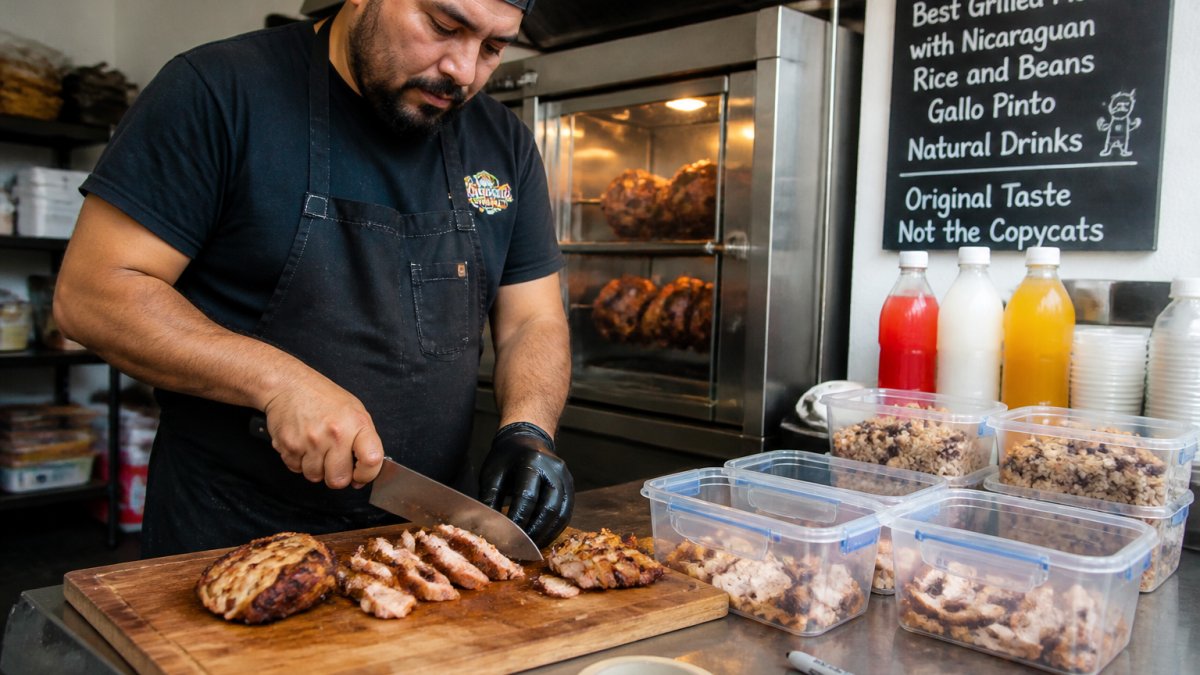
Storing barbecue leftovers right is the difference between a great next-day lunch and a sad, dry plate. The goal: cool fast, seal tight, label clearly.
The Temperature Targets That Drive Everything
A cheap refrigerator thermometer pays for itself here. Put one on a middle shelf, check it weekly, and stop guessing.
Cool It Fast: The Shallow-Pan Method
Instead:
- Break large cuts into smaller pieces and spread them in a shallow layer, no more than about two inches deep
- Leave containers uncovered in the fridge for 30 to 45 minutes so steam escapes, then seal
- Refrigerate within two hours of coming off the grate, one hour if the temp is above 90°F
Portion, Pack, and Label
- Divide into meal-sized portions before refrigerating, not after
- Pack in airtight containers or press heavy-duty wrap directly against the surface of the meat
- Squeeze out excess air from bags; oxygen speeds up off-flavors and freezer burn
Grilled Vegetables and Mixed Dishes Are Not the Same Clock
- Grilled vegetables: 3 to 4 days refrigerated. They spoil faster than meat once dressed, oil-and-vinegar marinades and charred edges shorten the window. Keep them separate so they don't make meat soggy.
- Grilled seafood: 3 days refrigerated, a firm ceiling. Seafood is the least forgiving item on the grill.
- Sauced or mixed dishes (grilled meat tossed with rice, beans, or a sauce-heavy side): 3 to 4 days, counted from the cook date of the earliest-cooked component.
Freezer: The Longer Game
For anything you won't eat within four days, freeze it. Grilled meat holds about three to four months at 0°F before quality, not safety, starts to slide. Wrap tight, label with cook and freeze dates, and use the oldest first.
How to Reheat Grilled Meat Without Drying It Out
Reheat grilled meat to 165°F to kill bacteria, using a low, gentle method to keep it moist.
The oven works well at 300°F to 325°F, covered with foil and a splash of broth or water, the steam keeps the meat tender.
For smaller portions, a skillet over low heat with a lid does the job.
Here is a tip from the pit: let meat rest about 30 minutes before reheating, as Kansas State University Extension food safety guidance notes for warming up.
Ordering Grilled Food for Pickup or Catering
Ordering grilled food for pickup or catering means planning the timing.
Our grilled meat comes with Nicaraguan rice and beans, gallo pinto, and natural drinks.
Our signature marinade and locally sourced ingredients bring bold, craveable flavor.
Customer service comes first for us. We keep our clients first so we can keep growing.
Best for: Families and offices ordering a weekend feast or a weekday lunch run.
Frequently Asked Questions
Is barbecue still good after 4 days?
Four days is the outer edge. The USDA Food Safety and Inspection Service puts refrigerated leftovers at three to four days, so a fourth day is the last one, not a comfortable margin. Anything past that should go. If you cooked a big batch and know you will not finish it, freeze half on day one instead of gambling on day four. Reheat only what you plan to eat, and never reheat the same portion twice.
Can grilled chicken last 7 days in the fridge?
No. Seven days is well beyond the recommended window for any cooked poultry. Grilled chicken should be eaten within three to four days of cooking, and sooner if it sat out at a picnic or on a patio table. Bacteria do not always change the smell or taste of food, so a piece that seems fine on day six is not proof of anything. Freeze portions you will not reach by day three.
Can you freeze grilled meat and sides?
Yes, and freezing is the better move when you have more than you can eat in a few days. The USDA puts frozen leftovers at three to four months for best quality. Cool the meat first, portion it into airtight containers or freezer bags, press out the air, and label with the date. Grilled vegetables and rice freeze well too. Thaw in the refrigerator overnight rather than on the counter.
How do you reheat grilled food without drying it out?
Low and covered beats hot and fast. Set the oven to 250 to 300 degrees Fahrenheit, add a splash of broth or a pat of butter, cover with foil, and warm until the center hits 165 degrees Fahrenheit on a thermometer. For single portions, a covered skillet with a spoonful of water works in a few minutes. Skip the microwave on high, which is what turns a good piece of grilled meat rubbery.
Grilled food is only as good as how you handle it after it leaves the heat. That is where we put our focus. El Gordo's Grill cooks with locally sourced ingredients and a signature marinade, packs for the trip, and treats every order like it matters. Get started with El Gordo's Grill and taste the original, from our grill to your table.